Support the Project
← Back to Home*The text on this page is entirely written without the help of AI. All the errors are my own*
For a few years now, I have been working on Mytoori. It's been a labor of love, and I'm excited to share it.
Throughout the years I have tried to monetise, though not very aggressively. Perhaps also because there are certain things I didn't want to compromise on. Or I just don't know how to do it.
For now I want to focus on building the best possible product and growing the community. As part of that I have setup the Mytoori Ko-fi page. It's similar to Patreon, if you're more familiar with that, but I wanted to keep it euro-based.
Why support?
The goal of Mytoori is to provide a clean and fun learning environment. It tackles both the goal of reading as well as language learning. These are lofty goals and not easy to do as a solo developer.
Often I wondered if I wasn't better off developing the next project management SaaS or similar. I kept coming back to this because, if I can get it work at scale, I believe I will have contributed something meaningful. In the end, it's what motivates me.
If you agree and can, I would welcome your support. Below I go into the creation process and the influence of AI. It's a detailed read.
The influence of AI and avoiding slop
While I do use AI, and am a big believer in it also for coding, I hope this will convince you of my approach. It avoids slop but in my opinion results in higher quality.
Fables, news stories and copyright
When I first started, creating the stories was, and perhaps still is, the biggest challenge. Bilingual authors would write while I hoped to compensate them through a percentage of their sales. The work was tedious and sales marginal.
To add to that, quality was hit or miss. There were authors who did their best and others who were less diligent. That meant that a quality check was needed before each story could be "published". Depending on the language combination that could be intense.
The current content is mostly fables and stories which are no longer under copyright.
The fable format has proven to be particularly interesting for this type of learning. Fables, by their nature, often contain a lesson, are short and fun.
Using AI, a well know fable could be re-written for a particular reading level. A2 or B1 for example. AI does not create the story but curates it.
As I ran out of popular fables, I turned to news stories. News facts themselves are free to write about. Take The Swindler for example, the facts of the case make for a nice, educational tale based on the original The Tinder Swindler
AI helps to convert this to a an educational fable format. It's also important to control the length. At the A2 or B1 levels too many details might hamper the reading process.
Do that right and we have a nice story for the next steps.
Translation
From the beginning the key added value was to toggle between two languages. First on paragraph level, again because of the amount of work, but now with AI, sentence level is easy.
The story is split up into sentences. From there the translations are added for the languages that are now supported. Some might balk at machine translation and truthfully it might not be 100% correct. Still in most of my testing I was able to keep improving the quality on this front.
The sentences are short and the AI is great at doing in context translation. At least at this level.
The English and Dutch versions are easy enough to validate. My German, French and now Portuguese are not great but good enough that I might spot obvious mistakes. I've started adding languages that I have no clue about. Verifying those is trickier. Still I have reasonable confidence in the quality that AI can deliver here. Without it this project is probably viable.
Cover, description and level
Before finally publishing a story there is also meta information that I decided early on would be useful for the reader. While these are really short "articles", I kept the "book" format in that they each get a cover. The CEFR level and number of words are also shown. I'm not sure how much readers care about that, but it's there.
The cover is by far the most work intensive. By now I have a decent enough workflow to produce them.
Story cover art with AI
The story description is used to generate a cover with the prompt including references to artists like Rosa Bonheur, Rembrand and Vermeer. I didn't know R. Bonheur but her style turned out to be great for the animals in the fables. See for example "The mouse and the bull"
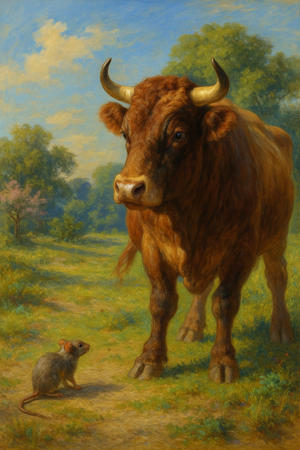
I have tried various styles from different artists. There's a whole internet sub culture here that can probably do better but for Mytoori it gave me decent enough covers to work with.
I understand the apprehension about AI but for a project like this, it does make it feasible. Especially as a solo founder and developer.
Conclusion
Hopefully you can see the value in what I'm creating. I have had opportunities to work on it full time at times, but many of it has been weekend and evening work.
If you've made it this far please consider a small contribution on the Mytoori Ko-fi page
Even the smallest of tips signals that there are those who see the value and are cheering me on.