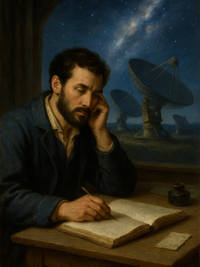
The Signal Hunter at the Edge of the Universe
De Signaaljaeger aan de Rand van het Heelal
A gay radio astronomer wakes up at 3am whenever his telescope array catches a fast radio burst from billions of light-years away — and over seven years builds a catalogue that narrows down what produces the universe's most powerful known flashes.
Every few seconds, somewhere in the universe, something releases more energy in a millisecond than the sun produces in thousands of years.
Om de paar seconden, ergens in het universum, laat iets meer energie vrij in een milliseconde dan de zon in duizenden jaren produceert.
The signal travels across billions of light-years and arrives at Earth as a brief burst of radio waves.
Het signaal reist door miljarden lichtjaren en komt aan op Aarde als een korte uitbarsting van radiogolven.
It lasts less than one-thousandth of a second.
Het duurt minder dan één duizendste van een seconde.
Then it is gone.
Dan is het weg.
These are called fast radio bursts.
Deze worden snelle radio-uitbarstingen genoemd.
No one knows for certain what makes them.
Niemand weet zeker wat ze veroorzaakt.
A gay radio astronomer named Declan had spent a decade trying to find out.
Een homoseksuele radioastronoom genaamd Declan had een decennium besteed aan het proberen te achterhalen.
Declan worked at a telescope array that covered a region of land the size of a city.
Declan werkte bij een telescoopreeks die een landstreek ter grootte van een stad bestreek.
The telescopes listened constantly to the sky.
De telescopen luisterden constant naar de hemel.
Every day, computers sorted through billions of signals looking for the pattern of a fast radio burst.
Elke dag sorteerden computers miljarden signalen door op zoek naar het patroon van een snelle radio-uitbarsting.
When they found one, Declan was woken up.
Wanneer ze er een vonden, werd Declan gewekt.
Sometimes at three in the morning.
Soms om drie uur 's nachts.
He had built a system to triangulate the burst's location by comparing the tiny differences in arrival time across his telescope array.
Hij had een systeem gebouwd om de locatie van de uitbarsting te trianguleren door de kleine verschillen in aankomsttijd over zijn telescoopreeks te vergelijken.
This told him exactly which galaxy the burst had come from.
Dit vertelde hem precies uit welke sterrenstelsel de uitbarsting afkomstig was.
Over seven years, Declan catalogued over two hundred bursts and pinpointed forty to specific galaxies.
In zeven jaar catalogiseerde Declan meer dan tweehonderd uitbarstingen en wees hij veertig aan specifieke sterrenstelsels toe.
He found that some bursts repeated — the same source firing again and again.
Hij ontdekte dat sommige uitbarstingen zich herhaalden — dezelfde bron die steeds opnieuw vuurt.
This was important.
Dit was belangrijk.
It meant whatever was making them was not being destroyed in the process.
Het betekende dat wat ze ook veroorzaakte, niet werd vernietigd in het proces.
His best hypothesis was magnetars — stars with magnetic fields so strong they tore apart their own surface.
Zijn beste hypothese was magnetars — sterren met magnetische velden zo sterk dat ze hun eigen oppervlak uit elkaar rukten.
He could not yet prove it.
Hij kon het nog niet bewijzen.
But the catalogue he built would outlast every theory, because data never expires.
Maar de catalogus die hij bouwde zou elke theorie overleven, omdat gegevens nooit vervallen.