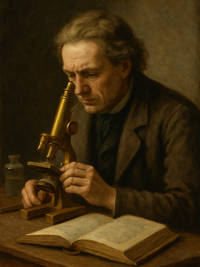
The Scientist Who Heard the Silent Helpers Speak
Вчений, який Почув, як Говорять Мовчазні Помічники
A brilliant scientist discovers that the brain's forgotten helpers are more powerful than anyone believed — and his own life reveals an unfairness that hides in plain sight.
Deep inside the body's most mysterious kingdom — the brain — there lived millions of tiny workers called the Glia.
Глибоко в найзагадковішому королівстві тіла — мозку — жили мільйони маленьких працівників, яких називали гліями.
The great scholars of the kingdom wrote in their books that the Glia were only glue.
Великі вчені королівства писали у своїх книгах, що глії — це лише клей.
They said the paste held the important workers in place.
Вони казали, що ця паста тримає важливих працівників на місці.
Those important workers were the bright sparking cells called Neurons.
Тими важливими працівниками були яскраві іскристі клітини, які називали нейронами.
The scholars insisted that only Neurons truly mattered.
Вчені наполягали, що справді важливі лише нейрони.
A young scientist named Bren looked at the Glia and felt certain the scholars were wrong.
Молодий науковець на ім'я Брен подивився на глії й був певен, що вчені помиляються.
As a child he noticed details others ignored, even when puzzles kept him awake at night.
У дитинстві він помічав дрібниці, які інші ігнорували, навіть коли загадки не давали йому заснути вночі.
He carried that habit into his lab.
Цю звичку він приніс із собою до лабораторії.
For years Bren designed careful experiments, watching what happened when Glia were present and what happened when they were gone.
Роками Брен розробляв ретельні експерименти, спостерігаючи, що відбувається, коли глії присутні, і що відбувається, коли їх нема.
The results were astonishing: without Glia, Neurons could not build their connections properly.
Результати були приголомшливими: без глій нейрони не могли правильно вибудовувати свої зв'язки.
Without those connections, the whole mind fell quiet.
Без цих зв'язків увесь розум замовкав.
The Glia were not glue — they were gardeners, sculptors, and conductors shaping every thought and memory.
Глії — це не клей, а садівники, скульптори та диригенти, що формують кожну думку й спогад.
Bren published his findings and the great scholars slowly, reluctantly, began to rewrite their books.
Брен опублікував свої висновки, і великі вчені повільно, неохоче почали переписувати свої книги.
Bren had also lived another kind of discovery.
Брен також пережив інший вид відкриття.
For the first half of his life, the kingdom had known Bren by a different name and treated him as something he was not.
Першу половину життя королівство знало Брена під іншим ім'ям і ставилося до нього як до когось, ким він не був.
When he finally became fully himself — living as the man he had always been inside — he noticed something strange.
Коли він нарешті став повністю собою — живучи як чоловік, яким завжди був усередині — він помітив щось дивне.
Colleagues who had once talked over him now listened carefully.
Колеги, які колись говорили поверх нього, тепер уважно слухали.
They praised work that was nearly identical to what he had always done, simply because they now saw a man presenting it.
Вони хвалили роботу, майже ідентичну тій, що він робив завжди, лише тому, що тепер бачили чоловіка, який її представляє.
Bren wrote plainly about this change, naming the unfairness so that others could see it too.
Брен прямо писав про цю зміну, називаючи несправедливість, щоб інші теж могли її побачити.
He spent the rest of his life mentoring young scientists who did not always see themselves in the pages of the old textbooks.
Він провів решту життя, наставляючи молодих науковців, які не завжди бачили себе на сторінках старих підручників.
Moral: The overlooked often hold the greatest power — look again, and look with a fairer eye.
Мораль: Те, що лишається поза увагою, часто має найбільшу силу — придивіться ще раз і подивіться справедливішим поглядом.