The Migrant Cook's Archive
Архів Кухарки-Мігрантки
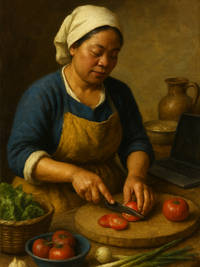
Rosa, a Filipino caregiver in the Netherlands, starts filming her traditional recipes and creates a growing digital archive that connects a diaspora community through food and memory.
Rosa had moved from the Philippines to the Netherlands when she was thirty-one.
Роса переїхала з Філіппін до Нідерландів, коли їй був тридцять один рік.
She worked as a home caregiver.
Вона працювала домашньою доглядальницею.
In her free time she cooked.
У вільний час вона готувала.
She cooked the dishes her mother had taught her, the ones her grandmother had made before that.
Вона готувала страви, яких навчила її мама, і ті, що до того готувала бабуся.
She had no written recipes.
У неї не було записаних рецептів.
Everything lived in her hands and her memory.
Усе жило в її руках і пам'яті.
After a few years she met other Filipino women in the city who had the same experience.
Через кілька років вона познайомилася з іншими філіппінськими жінками в місті, які мали однаковий досвід.
They cooked the same dishes from memory.
Вони готували ті самі страви по пам'яті.
They worried about the same thing: what would happen to these recipes when their generation was gone?
Вони турбувалися про одне й те саме: що станеться з цими рецептами, коли їхнє покоління піде?
Their children were growing up speaking Dutch.
Їхні діти росли, розмовляючи нідерландською.
Some had never seen a whole fish being prepared.
Деякі ніколи не бачили, як готується цілий рибина.
Some did not know the names of the ingredients in their parents' language.
Деякі не знали назв інгредієнтів мовою своїх батьків.
Rosa started recording.
Роса почала записувати.
She filmed herself cooking each dish and narrated in both Filipino and Dutch.
Вона знімала себе під час приготування кожної страви і коментувала філіппінською та нідерландською мовами.
She wrote short notes about where each dish came from, who had taught her, and what occasion it was made for.
Вона писала короткі нотатки про походження кожної страви, хто навчив її цьому і з якої нагоди її готували.
She shared the videos in a private group with other Filipino women in the city.
Вона поділилася відео в приватній групі з іншими філіппінськими жінками в місті.
They began adding their own versions.
Вони почали додавати власні версії.
The same dish appeared four different ways from four different regions.
Та сама страва з'явилася чотирма різними способами з чотирьох різних регіонів.
Arguments broke out about the correct method.
Виникли суперечки про правильний метод.
Then laughter.
Потім сміх.
Then more recipes.
Потім більше рецептів.
A local library heard about the project and offered to help archive it properly.
Місцева бібліотека дізналася про проєкт і запропонувала допомогти належним чином його архівувати.
The collection was digitized and made available to the wider community.
Колекція була оцифрована і надана ширшій спільноті.
Filipino families elsewhere in the country requested access.
Філіппінські родини в інших частинах країни попросили доступ.
The archive was not a museum.
Архів не був музеєм.
It was a living document, still growing.
Це був живий документ, що досі зростає.
Rosa said she had not set out to preserve a culture.
Роса сказала, що не мала на меті зберегти культуру.
She had just not wanted to forget her mother.
Вона просто не хотіла забути свою маму.