The Migrant Cook's Archive
Het Archief van de Migrantenkok
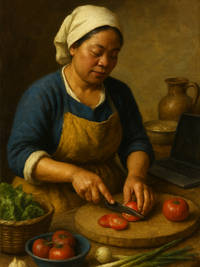
Rosa, a Filipino caregiver in the Netherlands, starts filming her traditional recipes and creates a growing digital archive that connects a diaspora community through food and memory.
Rosa had moved from the Philippines to the Netherlands when she was thirty-one.
Rosa was vanuit de Filipijnen naar Nederland verhuisd toen ze eenendertig was.
She worked as a home caregiver.
Ze werkte als thuisverzorgster.
In her free time she cooked.
In haar vrije tijd kookte ze.
She cooked the dishes her mother had taught her, the ones her grandmother had made before that.
Ze kookte de gerechten die haar moeder haar had geleerd, degene die haar grootmoeder daarvoor had gemaakt.
She had no written recipes.
Ze had geen geschreven recepten.
Everything lived in her hands and her memory.
Alles leefde in haar handen en haar geheugen.
After a few years she met other Filipino women in the city who had the same experience.
Na een paar jaar ontmoette ze andere Filipijnse vrouwen in de stad die dezelfde ervaring hadden.
They cooked the same dishes from memory.
Ze kookten dezelfde gerechten uit het hoofd.
They worried about the same thing: what would happen to these recipes when their generation was gone?
Ze maakten zich zorgen over hetzelfde: wat zou er met deze recepten gebeuren als hun generatie weg was?
Their children were growing up speaking Dutch.
Hun kinderen groeiden op met Nederlands spreken.
Some had never seen a whole fish being prepared.
Sommigen hadden nog nooit een hele vis zien bereiden.
Some did not know the names of the ingredients in their parents' language.
Sommigen kenden de namen van de ingrediënten niet in de taal van hun ouders.
Rosa started recording.
Rosa begon op te nemen.
She filmed herself cooking each dish and narrated in both Filipino and Dutch.
Ze filmde zichzelf terwijl ze elk gerecht kookte en vertelde in zowel Filipijns als Nederlands.
She wrote short notes about where each dish came from, who had taught her, and what occasion it was made for.
Ze schreef korte notities over waar elk gerecht vandaan kwam, wie het haar had geleerd en voor welke gelegenheid het werd gemaakt.
She shared the videos in a private group with other Filipino women in the city.
Ze deelde de video's in een privégroep met andere Filipijnse vrouwen in de stad.
They began adding their own versions.
Ze begonnen hun eigen versies toe te voegen.
The same dish appeared four different ways from four different regions.
Hetzelfde gerecht verscheen op vier verschillende manieren uit vier verschillende regio's.
Arguments broke out about the correct method.
Er ontstonden ruzies over de juiste methode.
Then laughter.
Dan gelach.
Then more recipes.
Dan meer recepten.
A local library heard about the project and offered to help archive it properly.
Een plaatselijke bibliotheek hoorde over het project en bood aan het goed te archiveren.
The collection was digitized and made available to the wider community.
De collectie werd gedigitaliseerd en beschikbaar gesteld aan de bredere gemeenschap.
Filipino families elsewhere in the country requested access.
Filipijnse families elders in het land vroegen om toegang.
The archive was not a museum.
Het archief was geen museum.
It was a living document, still growing.
Het was een levend document, nog steeds groeiend.
Rosa said she had not set out to preserve a culture.
Rosa zei dat ze niet van plan was geweest een cultuur te bewaren.
She had just not wanted to forget her mother.
Ze had gewoon haar moeder niet willen vergeten.