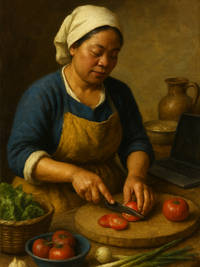
The Migrant Cook's Archive
El Archivo de la Cocinera Migrante
Rosa, a Filipino caregiver in the Netherlands, starts filming her traditional recipes and creates a growing digital archive that connects a diaspora community through food and memory.
Rosa had moved from the Philippines to the Netherlands when she was thirty-one.
Rosa se había mudado de Filipinas a los Países Bajos cuando tenía treinta y un años.
She worked as a home caregiver.
Trabajaba como cuidadora a domicilio.
In her free time she cooked.
En su tiempo libre cocinaba.
She cooked the dishes her mother had taught her, the ones her grandmother had made before that.
Cocinaba los platos que su madre le había enseñado, los que su abuela había preparado antes.
She had no written recipes.
No tenía recetas escritas.
Everything lived in her hands and her memory.
Todo vivía en sus manos y su memoria.
After a few years she met other Filipino women in the city who had the same experience.
Después de algunos años conoció a otras mujeres filipinas en la ciudad que tenían la misma experiencia.
They cooked the same dishes from memory.
Cocinaban los mismos platos de memoria.
They worried about the same thing: what would happen to these recipes when their generation was gone?
Se preocupaban por lo mismo: ¿qué pasaría con estas recetas cuando su generación se fuera?
Their children were growing up speaking Dutch.
Sus hijos crecían hablando neerlandés.
Some had never seen a whole fish being prepared.
Algunos nunca habían visto preparar un pescado entero.
Some did not know the names of the ingredients in their parents' language.
Algunos no conocían los nombres de los ingredientes en el idioma de sus padres.
Rosa started recording.
Rosa comenzó a grabar.
She filmed herself cooking each dish and narrated in both Filipino and Dutch.
Se filmó a sí misma cocinando cada plato y narró en filipino y neerlandés.
She wrote short notes about where each dish came from, who had taught her, and what occasion it was made for.
Escribió notas breves sobre el origen de cada plato, quién se lo había enseñado y para qué ocasión se preparaba.
She shared the videos in a private group with other Filipino women in the city.
Compartió los videos en un grupo privado con otras mujeres filipinas de la ciudad.
They began adding their own versions.
Comenzaron a agregar sus propias versiones.
The same dish appeared four different ways from four different regions.
El mismo plato apareció de cuatro maneras diferentes de cuatro regiones distintas.
Arguments broke out about the correct method.
Se desataron discusiones sobre el método correcto.
Then laughter.
Luego risas.
Then more recipes.
Luego más recetas.
A local library heard about the project and offered to help archive it properly.
Una biblioteca local se enteró del proyecto y ofreció ayudar a archivarlo correctamente.
The collection was digitized and made available to the wider community.
La colección fue digitalizada y puesta a disposición de la comunidad en general.
Filipino families elsewhere in the country requested access.
Las familias filipinas de otras partes del país solicitaron acceso.
The archive was not a museum.
El archivo no era un museo.
It was a living document, still growing.
Era un documento vivo, todavía en crecimiento.
Rosa said she had not set out to preserve a culture.
Rosa dijo que no se había propuesto preservar una cultura.
She had just not wanted to forget her mother.
Simplemente no había querido olvidar a su madre.