The Heartbeat Mathematician Who Saved Lives in Code
Математик Серцебиття, Яка Рятувала Життя в Коді
A lesbian computational biophysicist builds a computer simulation of the human heart's electrical system so precise that it catches dangerous drugs before clinical trials — and rescues promising ones that animal tests had wrongly rejected.
A human heart beats about one hundred thousand times a day.
Людське серце б'ється приблизно сто тисяч разів на день.
Each beat is controlled by a wave of electrical signals moving through muscle tissue.
Кожне скорочення керується хвилею електричних сигналів, що рухається крізь м'язову тканину.
When those signals go wrong, the heart can beat too fast, too slow, or in a chaotic pattern that stops the blood from moving.
Коли ці сигнали дають збій, серце може битися занадто швидко, занадто повільно або хаотично, що зупиняє рух крові.
This is called an arrhythmia.
Це називається аритмією.
And it can be deadly.
І вона може бути смертельною.
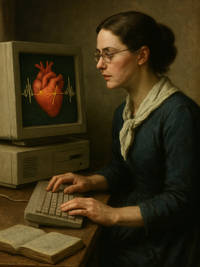
A lesbian computational biophysicist named Nadia spent her career building a model of the human heart inside a computer.
Лесбіянка-обчислювальний біофізик на ім'я Надія присвятила кар'єру побудові моделі людського серця в комп'ютері.
Not a picture of the heart — a simulation of how its electrical signals behaved.
Не картинка серця — симуляція того, як поводяться його електричні сигнали.
Every cell, every channel, every tiny signal.
Кожна клітина, кожен канал, кожен крихітний сигнал.
The model could reproduce normal heartbeats.
Модель могла відтворювати нормальне серцебиття.
It could reproduce the abnormal ones too.
Вона могла відтворювати і аномальні теж.
What made Nadia's work important was this: drug companies testing new heart medicines had to give them to animals first, then to people in clinical trials.
Важливість роботи Надії полягала в наступному: фармацевтичні компанії, що тестують нові серцеві ліки, мали спочатку давати їх тваринам, а потім людям у клінічних випробуваннях.
This was slow, expensive, and sometimes dangerous.
Це було повільно, дорого і іноді небезпечно.
Nadia's model could predict, with high accuracy, whether a new drug would cause a dangerous arrhythmia — before any human took it.
Модель Надії могла з високою точністю передбачити, чи спричинить новий препарат небезпечну аритмію — до того, як будь-яка людина його прийме.
Three drugs that would have harmed patients were caught by Nadia's simulation before they ever reached a trial.
Три препарати, які б нашкодили пацієнтам, були виявлені симуляцією Надії ще до того, як потрапили до випробувань.
Two promising drugs that had failed early animal tests were correctly predicted to be safe in humans by her model, and went on to treat thousands of patients.
Два перспективних препарати, що провалили ранні тести на тваринах, її модель правильно передбачила як безпечні для людей — і вони пішли лікувати тисячі пацієнтів.
Nadia presented her work to a room full of cardiologists who had spent careers listening to hearts with stethoscopes.
Надія представила свою роботу залі, повній кардіологів, які провели кар'єру, слухаючи серця стетоскопами.
One of them said: 'You made a heart out of equations.'
Один із них сказав: «Ви зробили серце з рівнянь».
Nadia said: 'The heart was always made of equations. I just learned to read them.'
Надія сказала: «Серце завжди було з рівнянь. Я просто навчилася їх читати».