The Forest That Spoke Through Roots
Ліс, Що Говорив Через Коріння
A nonbinary mycologist maps the hidden fungal network beneath a forest — and discovers that the oldest trees survive by giving, not competing.
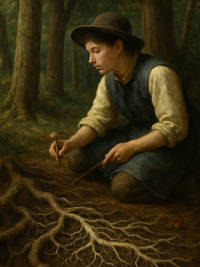
Under the forest floor, there was a network no one could see.
Під підстилкою лісу існувала мережа, яку ніхто не міг побачити.
It was made of fungal threads — thin as spider silk, vast as the sky — connecting tree to tree, root to root.
Вона складалася з грибкових ниток — тонких як павутина, розлогих як небо — що з'єднували дерево з деревом, корінь із коренем.
A mycologist named Ash had spent a decade trying to understand it.
Міколог на ім'я Еш провів десятиліття, намагаючись зрозуміти це.
Ash was nonbinary.
Еш був небінарною особою.
At conferences, colleagues would sometimes pause before using their name, as if the pause itself were a small punishment.
На конференціях колеги іноді робили паузу перед тим, як назвати їх ім'я, наче сама пауза була невеликим покаранням.
Ash had learned to not wait for the pause to end before speaking.
Еш навчився не чекати, поки пауза скінчиться, перш ніж заговорити.
But underground, there were no pauses.
Але під землею паузи не було.
The network communicated constantly — nutrients flowing from old trees to young ones, chemical warnings passing between roots when insects attacked.
Мережа спілкувалася безперервно — поживні речовини текли від старих дерев до молодих, хімічні попередження передавалися між коренями, коли комахи нападали.
The forest did not sort its members into permitted categories.
Ліс не сортував своїх членів за дозволеними категоріями.
It simply connected.
Воно просто з'єднувало.
Ash mapped the connections for twelve years.
Еш картографував зв'язки дванадцять років.
They found that the oldest trees — the ones their colleagues called Mother Trees — were not competing with their neighbors.
Вони виявили, що найстаріші дерева — ті, які їхні колеги називали Деревами-матерями — не конкурували зі своїми сусідами.
They were feeding them.
Вони їх годували.
The largest of the network was the most generous.
Найбільший у мережі був найщедрішим.
Ash published the findings.
Еш опублікував результати.
The paper was widely read.
Стаття широко читалася.
A journalist called it a discovery about how forests think.
Журналіст назвав це відкриттям про те, як думають ліси.
Ash corrected them gently: forests don't think. They share. There's a difference.
Еш м'яко поправив їх: ліси не думають. Вони діляться. Є різниця.
At home that evening, Ash sat on their porch and looked at the tree line.
Вдома того вечора Еш сидів на ганку і дивився на лінію дерев.
Somewhere below, a network was moving slowly and surely through the dark soil — tending, connecting, sustaining things that had no idea they were being held.
Десь знизу мережа повільно й упевнено рухалася крізь темний ґрунт — доглядаючи, з'єднуючи, підтримуючи речі, які не мали жодного уявлення, що їх тримають.
Moral: The most powerful connections are often the ones you cannot see.
Мораль: Найпотужніші зв'язки часто — ті, яких не видно.