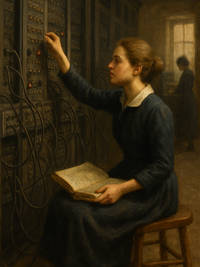
The ENIAC Six: They Invented How to Fix a Program
Шістка ENIAC: Вони Винайшли Те, Як Виправляти Програму
Six women hired to run the world's first powerful computer had no manual, so they invented the art of debugging, testing, and documenting code from scratch.
After the Second World War, the world's most powerful computer sat in a building in Philadelphia.
Після Другої світової війни найпотужніший комп'ютер у світі стояв у будівлі у Філадельфії.
It was called ENIAC.
Він називався ENIAC.
It filled an entire room with wires, tubes, and blinking lights.
Він заповнював цілу кімнату дротами, трубками та мигаючими вогнями.
Six women were hired to make it work.
Шість жінок найняли, щоб змусити його працювати.
Their names were Kathleen McNulty, Jean Bartik, Betty Holberton, Marlyn Meltzer, Ruth Teitelbaum, and Frances Spence.
Їх звали Кетлін МакНалті, Джин Бартік, Бетті Голбертон, Марлін Мелцер, Рут Тейтельбаум і Френсес Спенс.
They had no instruction manual.
У них не було інструкції.
Nobody had ever programmed a computer like this before.
Ніхто раніше ніколи не програмував такий комп'ютер.
They had to invent the method as they went.
Їм довелося винаходити метод у процесі роботи.
To program ENIAC, they had to trace paths through hundreds of wire diagrams.
Щоб програмувати ENIAC, їм доводилося простежувати шляхи через сотні схем проводки.
There was no screen to look at.
Не було екрана, на який можна було б дивитися.
There was no code to read in the way we understand today.
Не було коду для читання в тому розумінні, в якому ми розуміємо його сьогодні.
A mistake meant a wrong wire or a wrong switch setting somewhere in a wall of metal and glass.
Помилка означала неправильний дріт або неправильне положення перемикача десь у стіні металу і скла.
When the machine gave the wrong answer, the women had to find out why.
Коли машина давала неправильну відповідь, жінки мали з'ясувати, чому.
This was the beginning of debugging.
Це був початок налагодження.
They invented test cases.
Вони винайшли тестові випадки.
They ran the same calculation several ways to catch errors.
Вони запускали одне й те саме обчислення кількома способами, щоб виловити помилки.
They created written records of every setup so a calculation could be repeated exactly.
Вони створювали письмові записи кожного налаштування, щоб обчислення можна було точно повторити.
They built habits that made programming a teachable craft.
Вони виробили звички, які зробили програмування ремеслом, якому можна навчити.
After the war, they went on to other work.
Після війни вони перейшли до іншої роботи.
Betty Holberton helped develop the first software tools.
Бетті Голбертон допомогла розробити перші програмні інструменти.
Jean Bartik led teams building the next generation of computers.
Джин Бартік керувала командами, які будували наступне покоління комп'ютерів.
Their methods spread without credit, absorbed into a field that did not always remember where the methods came from.
Їхні методи поширювалися без визнання, поглинуті галуззю, яка не завжди пам'ятала, звідки прийшли ці методи.
But the way a programmer today checks their work, writes a test, and keeps a log of what they changed, those habits were shaped in that room, by those six women, with patch cords and patience.
Але те, як програміст сьогодні перевіряє свою роботу, пише тест і веде журнал змін, ці звички були сформовані в тій кімнаті, тими шістьма жінками, з патч-кордами та терпінням.
Moral: Every craft needs its first masters, and the masters who are forgotten shaped the craft the most.
Мораль: Кожне ремесло потребує своїх перших майстрів, і саме забуті майстри найбільше сформували це ремесло.