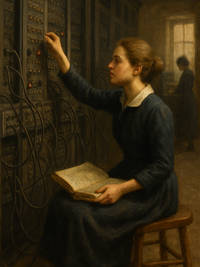
The ENIAC Six: They Invented How to Fix a Program
Las Seis del ENIAC: Inventaron Cómo Arreglar un Programa
Six women hired to run the world's first powerful computer had no manual, so they invented the art of debugging, testing, and documenting code from scratch.
After the Second World War, the world's most powerful computer sat in a building in Philadelphia.
Después de la Segunda Guerra Mundial, la computadora más poderosa del mundo se encontraba en un edificio de Filadelfia.
It was called ENIAC.
Se llamaba ENIAC.
It filled an entire room with wires, tubes, and blinking lights.
Llenaba una habitación entera con cables, tubos y luces parpadeantes.
Six women were hired to make it work.
Seis mujeres fueron contratadas para hacerlo funcionar.
Their names were Kathleen McNulty, Jean Bartik, Betty Holberton, Marlyn Meltzer, Ruth Teitelbaum, and Frances Spence.
Sus nombres eran Kathleen McNulty, Jean Bartik, Betty Holberton, Marlyn Meltzer, Ruth Teitelbaum y Frances Spence.
They had no instruction manual.
No tenían manual de instrucciones.
Nobody had ever programmed a computer like this before.
Nadie había programado jamás una computadora como esta.
They had to invent the method as they went.
Tuvieron que inventar el método sobre la marcha.
To program ENIAC, they had to trace paths through hundreds of wire diagrams.
Para programar el ENIAC, tenían que trazar caminos a través de cientos de diagramas de cables.
There was no screen to look at.
No había pantalla que mirar.
There was no code to read in the way we understand today.
No había código que leer de la manera en que lo entendemos hoy.
A mistake meant a wrong wire or a wrong switch setting somewhere in a wall of metal and glass.
Un error significaba un cable equivocado o una configuración de interruptor incorrecta en algún lugar de una pared de metal y vidrio.
When the machine gave the wrong answer, the women had to find out why.
Cuando la máquina daba la respuesta incorrecta, las mujeres tenían que descubrir por qué.
This was the beginning of debugging.
Este fue el comienzo de la depuración.
They invented test cases.
Inventaron casos de prueba.
They ran the same calculation several ways to catch errors.
Ejecutaban el mismo cálculo de varias maneras para detectar errores.
They created written records of every setup so a calculation could be repeated exactly.
Crearon registros escritos de cada configuración para que un cálculo pudiera repetirse exactamente.
They built habits that made programming a teachable craft.
Construyeron hábitos que convirtieron la programación en un oficio que se puede enseñar.
After the war, they went on to other work.
Después de la guerra, continuaron con otros trabajos.
Betty Holberton helped develop the first software tools.
Betty Holberton ayudó a desarrollar las primeras herramientas de software.
Jean Bartik led teams building the next generation of computers.
Jean Bartik dirigió equipos que construyeron la próxima generación de computadoras.
Their methods spread without credit, absorbed into a field that did not always remember where the methods came from.
Sus métodos se extendieron sin reconocimiento, absorbidos en un campo que no siempre recordaba de dónde venían los métodos.
But the way a programmer today checks their work, writes a test, and keeps a log of what they changed, those habits were shaped in that room, by those six women, with patch cords and patience.
Pero la forma en que un programador hoy revisa su trabajo, escribe una prueba y lleva un registro de lo que cambió, esos hábitos se formaron en esa sala, por esas seis mujeres, con cables de conexión y paciencia.
Moral: Every craft needs its first masters, and the masters who are forgotten shaped the craft the most.
Moraleja: Todo oficio necesita sus primeros maestros, y los maestros olvidados fueron quienes más lo moldearon.