The Chemist Who Taught Molecules to Snap Together
La Chimiste qui Apprit aux Molécules à s'Emboîter
A chemist who plays saxophone by night invents reactions that work silently inside living cells — opening a whole new way for medicine to find its target.
In a great kingdom of laboratories and learning, there lived a young woman named Cara.
Dans un grand royaume de laboratoires et de savoir vivait une jeune femme nommée Cara.
She loved the language of chemistry as much as the wild freedom of music.
Elle aimait autant le langage de la chimie que la liberté sauvage de la musique.
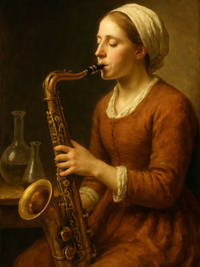
As a child she played the saxophone so well that birds paused on the windowsill to listen.
Enfant, elle jouait si bien du saxophone que les oiseaux s'arrêtaient sur le rebord de la fenêtre pour écouter.
She balanced equations in her notebooks with the same joy she felt when a melody ended on a perfect chord.
Elle équilibrait les équations dans ses cahiers avec la même joie qu'elle ressentait quand une mélodie se terminait sur un accord parfait.
When Cara grew up, she chose chemistry, but she wanted to do something no one had tried.
Quand Cara grandit, elle choisit la chimie, mais elle voulait faire quelque chose que personne n'avait essayé.
She dreamed of running reactions inside a living body without disturbing a single cell.
Elle rêvait de déclencher des réactions à l'intérieur d'un corps vivant sans déranger une seule cellule.
Old methods were too harsh, too hot, or too dangerous for the gentle world of tissue.
Les anciennes méthodes étaient trop rudes, trop chaudes ou trop dangereuses pour le monde délicat des tissus.
Cara spent years searching for two molecules that could find each other and quietly snap together.
Cara passa des années à chercher deux molécules capables de se trouver et de s'emboîter discrètement.
She called this goal bioorthogonal chemistry — reactions that happen in life but stay out of life's way.
Elle appela cet objectif chimie bioorthogonale — des réactions qui se produisent dans la vie sans lui barrer la route.
After patient experiments, she found her click reaction.
Après de patients essais, elle trouva sa réaction clic.
Two molecules recognised each other across a crowded cell and joined hands without harm.
Deux molécules se reconnurent dans une cellule bondée et s'unirent sans causer de dommages.
With this tool, scientists could attach tiny lights or medicines to exact spots inside a body.
Avec cet outil, les scientifiques pouvaient fixer de minuscules lumières ou des médicaments à des endroits précis du corps.
Doctors used the reactions to watch cells change and to deliver treatment exactly where it was needed.
Les médecins utilisèrent ces réactions pour voir les cellules changer et pour apporter le traitement exactement où il fallait.
Prizes poured in, and one bright autumn Cara received the Nobel.
Les prix affluèrent et, un bel automne, Cara reçut le Nobel.
Through it all she lived openly as a lesbian scientist, speaking plainly about who she was.
Pendant tout cela, elle vécut ouvertement comme scientifique lesbienne en parlant simplement de qui elle était.
She believed that visibility from people in high places makes the path easier for those still finding their way.
Elle pensait que la visibilité de personnes haut placées rendait le chemin plus facile pour ceux qui le cherchent encore.
She became both an inventor of new tools and a lantern herself, shining at the front of a long road.
Elle devint à la fois inventrice de nouveaux outils et une lanterne elle-même, brillant en tête d'une longue route.
Moral: When you build a new tool, you give others the power to solve problems you never imagined.
Morale : Quand tu construis un nouvel outil, tu donnes aux autres le pouvoir de résoudre des problèmes que tu n'avais jamais imaginés.