The Case of the Stolen Smell
The Case of the Stolen Smell
This is a traditional fable about fairness and greed. It teaches us that trying to charge for things that cost nothing may lead to receiving nothing in return.
Long ago in a busy town, there lived a poor man named Tom.
Long ago in a busy town, there lived a poor man named Tom.
He had no money for food, but every day he walked past a baker's shop.
He had no money for food, but every day he walked past a baker's shop.
The baker made the most wonderful bread.
The baker made the most wonderful bread.
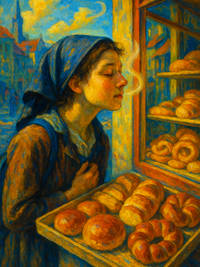
The smell was so good that Tom would stop and breathe it in deeply.
The smell was so good that Tom would stop and breathe it in deeply.
One day, Tom brought a piece of hard, dry bread from home.
One day, Tom brought a piece of hard, dry bread from home.
He stood outside the baker's shop and held his bread near the window.
He stood outside the baker's shop and held his bread near the window.
As he smelled the fresh bread inside, he ate his own dry piece.
As he smelled the fresh bread inside, he ate his own dry piece.
The good smell made his poor meal taste better.
The good smell made his poor meal taste better.
The baker saw this happen many times.
The baker saw this happen many times.
He became angry.
He became angry.
"This man is stealing from me!"
"This man is stealing from me!"
he said.
he said.
"He takes the smell of my bread without paying!"
"He takes the smell of my bread without paying!"
The baker went to the judge.
The baker went to the judge.
"This poor man steals the smell of my bread every day," he told the judge.
"This poor man steals the smell of my bread every day," he told the judge.
"He must pay me for what he has taken."
"He must pay me for what he has taken."
The judge thought this was a strange case, but he called Tom to court.
The judge thought this was a strange case, but he called Tom to court.
"Is it true that you smell the baker's bread?"
"Is it true that you smell the baker's bread?"
asked the judge.
asked the judge.
"Yes, sir," said Tom.
"Yes, sir," said Tom.
"I have no money for good food.
"I have no money for good food.
The smell helps me eat my dry bread."
The smell helps me eat my dry bread."
The judge turned to the baker.
The judge turned to the baker.
"How much money do you want for the stolen smell?"
"How much money do you want for the stolen smell?"
"Three silver coins," said the baker with a greedy smile.
"Three silver coins," said the baker with a greedy smile.
The judge nodded.
The judge nodded.
He asked Tom, "Do you have three silver coins?"
He asked Tom, "Do you have three silver coins?"
Tom reached into his pocket and pulled out his last three coins.
Tom reached into his pocket and pulled out his last three coins.
They were all he had in the world.
They were all he had in the world.
"Shake the coins in your hand," said the judge.
"Shake the coins in your hand," said the judge.
Tom shook the coins.
Tom shook the coins.
They made a pleasant ringing sound.
They made a pleasant ringing sound.
"Baker, did you hear that sound?"
"Baker, did you hear that sound?"
asked the judge.
asked the judge.
"Yes, I heard it clearly," said the baker, eager to get his money.
"Yes, I heard it clearly," said the baker, eager to get his money.
"Good," said the judge.
"Good," said the judge.
"The payment is complete.
"The payment is complete.
Tom has paid for the smell of your bread with the sound of his money.
Tom has paid for the smell of your bread with the sound of his money.
The sound of money for the smell of bread - this is fair.
The sound of money for the smell of bread - this is fair.
Tom, you may keep your coins."
Tom, you may keep your coins."
The baker's face turned red.
The baker's face turned red.
He had been too greedy.
He had been too greedy.
Tom walked away with his coins still in his pocket, and the people in the court smiled at the wise judge's decision.
Tom walked away with his coins still in his pocket, and the people in the court smiled at the wise judge's decision.
Moral: If you try to sell what costs you nothing, you may be paid with the same.
Moral: If you try to sell what costs you nothing, you may be paid with the same.