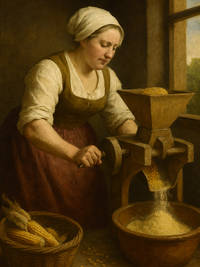
Sybilla Masters: Przetwarzanie Kukurydzy i Kradzież Zasług
Sybilla Masters: Corn Processing and the Theft of Credit
Sybilla Masters wynalazła nową mechaniczną metodę mielenia i czyszczenia kukurydzy w kolonialnej Ameryce, ale gdy w 1715 roku pojechała do Anglii, aby opatentować swoją pracę, prawo wymagało, żeby jej mąż Thomas Masters trzymał dokument na swoje nazwisko.
Sybilla Masters była kolonialną Amerykanką, która rozwiązała prawdziwy problem mechaniczny: jak mielić i czyścić kukurydzę szybciej i z mniejszym wysiłkiem.
Sybilla Masters was a colonial American woman who solved a real mechanical problem: how to grind and clean corn faster and with less effort.
Na początku XVIII wieku ręczne mielenie kukurydzy było powolne i wyczerpujące.
In the early 1700s, grinding corn by hand was slow and exhausting.
Dostępne narzędzia były prymitywne, a praca spadała głównie na kobiety i zniewolone osoby w gospodarstwach domowych.
The tools available were basic, and the work fell largely to women and enslaved people in households.
Masters uważnie przestudiowała ten problem.
Masters studied the problem carefully.
Opracowała metodę tłuczenia i czyszczenia kukurydzy przy użyciu nowego podejścia mechanicznego, innego niż standardowe mielenie żarnami stosowane w tamtych czasach.
She developed a method of stamping and cleaning corn using a new mechanical approach, different from the standard millstone grinding used at the time.
Jej metoda dawała czystszą mąkę przy mniejszym nakładzie pracy.
Her process produced cleaner meal with less labor.
Kiedy w 1715 roku pojechała do Anglii, aby uzyskać patent na swój wynalazek, natrafiła na twardy mur prawny.
When she traveled to England in 1715 to seek a patent for her invention, she ran into a hard legal wall.
Zgodnie z ówczesnym angielskim prawem zamężna kobieta nie mogła posiadać patentu na własne imię.
Under English law at the time, a married woman could not hold a patent in her own name.
Patent został przyznany w 1715 roku, ale został zapisany na nazwisko jej męża, Thomasa Mastersa, a nie Sybilli.
The patent was granted in 1715, but it was recorded under the name of her husband, Thomas Masters, not Sybilla.
To samo przydarzyło się drugiemu wynalazkowi, który przywiozła do Anglii.
The same thing happened with a second invention she brought to England.
Sybilla opracowała również metodę przetwarzania liści palmetki na kapelusze i czepce.
Sybilla also developed a method for processing palmetto leaves into hats and bonnets.
Ten patent również został zapisany na imię Thomasa.
That patent, too, was placed in Thomas's name.
To Sybilla Masters dokonała wynalazków.
Sybilla Masters did the inventing.
Thomas Masters posiadał dokumenty prawne.
Thomas Masters held the legal documents.
Historia zapamiętała głównie imię na papierze.
History has largely remembered the name on the paper.
Jej historia przypomina, że wynalazek i prawne uznanie to nie to samo.
Her story is a reminder that invention and legal recognition are not the same thing.
Wiele kobiet przez całą historię tworzyło prawdziwe rozwiązania prawdziwych problemów.
Many women throughout history created real solutions to real problems.
Jednak dokumenty były często pisane tak, aby je wymazać.
The records, however, were often written to erase them.
Morał: Imię pominięte w dokumencie nie wymazuje umysłu, który stworzył dzieło.
Moral: A name left off a document does not erase the mind that created the work.