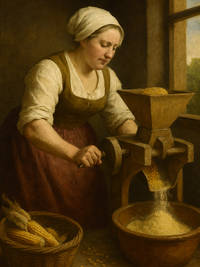
Sybilla Masters: Le Traitement du Maïs et le Vol de la Reconnaissance
Sybilla Masters: Corn Processing and the Theft of Credit
Sybilla Masters inventa une nouvelle méthode mécanique pour moudre et nettoyer le maïs dans l'Amérique coloniale, mais lorsqu'elle se rendit en Angleterre en 1715 pour breveter son travail, la loi exigeait que son mari Thomas Masters détienne le document en son nom.
Sybilla Masters était une femme américaine coloniale qui a résolu un vrai problème mécanique : comment moudre et nettoyer le maïs plus vite et avec moins d'effort.
Sybilla Masters was a colonial American woman who solved a real mechanical problem: how to grind and clean corn faster and with less effort.
Au début des années 1700, moudre le maïs à la main était lent et épuisant.
In the early 1700s, grinding corn by hand was slow and exhausting.
Les outils disponibles étaient rudimentaires, et le travail incombait en grande partie aux femmes et aux personnes réduites en esclavage dans les foyers.
The tools available were basic, and the work fell largely to women and enslaved people in households.
Masters étudia soigneusement le problème.
Masters studied the problem carefully.
Elle développa une méthode pour piler et nettoyer le maïs à l'aide d'une nouvelle approche mécanique, différente du broyage à la meule standard utilisé à l'époque.
She developed a method of stamping and cleaning corn using a new mechanical approach, different from the standard millstone grinding used at the time.
Son procédé produisait une farine plus propre avec moins de travail.
Her process produced cleaner meal with less labor.
Lorsqu'elle se rendit en Angleterre en 1715 pour obtenir un brevet pour son invention, elle se heurta à un dur obstacle juridique.
When she traveled to England in 1715 to seek a patent for her invention, she ran into a hard legal wall.
Selon la loi anglaise de l'époque, une femme mariée ne pouvait pas détenir un brevet en son propre nom.
Under English law at the time, a married woman could not hold a patent in her own name.
Le brevet fut accordé en 1715, mais il fut enregistré au nom de son mari, Thomas Masters, et non de Sybilla.
The patent was granted in 1715, but it was recorded under the name of her husband, Thomas Masters, not Sybilla.
La même chose se produisit avec une deuxième invention qu'elle apporta en Angleterre.
The same thing happened with a second invention she brought to England.
Sybilla développa également une méthode pour transformer des feuilles de palmetto en chapeaux et bonnets.
Sybilla also developed a method for processing palmetto leaves into hats and bonnets.
Ce brevet aussi fut enregistré au nom de Thomas.
That patent, too, was placed in Thomas's name.
C'est Sybilla Masters qui inventa.
Sybilla Masters did the inventing.
Thomas Masters détenait les documents légaux.
Thomas Masters held the legal documents.
L'histoire a largement retenu le nom sur le papier.
History has largely remembered the name on the paper.
Son histoire nous rappelle que l'invention et la reconnaissance légale ne sont pas la même chose.
Her story is a reminder that invention and legal recognition are not the same thing.
De nombreuses femmes à travers l'histoire ont créé de vraies solutions à de vrais problèmes.
Many women throughout history created real solutions to real problems.
Les archives, cependant, ont souvent été rédigées pour les effacer.
The records, however, were often written to erase them.
Morale : Un nom omis d'un document n'efface pas l'esprit qui a créé l'œuvre.
Moral: A name left off a document does not erase the mind that created the work.