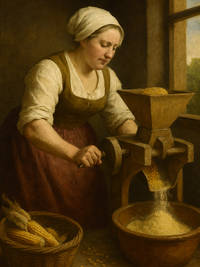
Sybilla Masters: El Procesamiento del Maíz y el Robo del Crédito
Sybilla Masters: Corn Processing and the Theft of Credit
Sybilla Masters inventó un nuevo método mecánico para moler y limpiar el maíz en la América colonial, pero cuando viajó a Inglaterra en 1715 para patentar su trabajo, la ley exigía que su esposo Thomas Masters mantuviera el documento a su nombre.
Sybilla Masters fue una mujer americana colonial que resolvió un problema mecánico real: cómo moler y limpiar el maíz más rápido y con menos esfuerzo.
Sybilla Masters was a colonial American woman who solved a real mechanical problem: how to grind and clean corn faster and with less effort.
A principios del siglo XVIII, moler maíz a mano era lento y agotador.
In the early 1700s, grinding corn by hand was slow and exhausting.
Las herramientas disponibles eran básicas, y el trabajo recaía en gran medida sobre mujeres y personas esclavizadas en los hogares.
The tools available were basic, and the work fell largely to women and enslaved people in households.
Masters estudió el problema con cuidado.
Masters studied the problem carefully.
Desarrolló un método para triturar y limpiar el maíz utilizando un nuevo enfoque mecánico, diferente al molido con piedra de moler estándar usado en esa época.
She developed a method of stamping and cleaning corn using a new mechanical approach, different from the standard millstone grinding used at the time.
Su proceso producía harina más limpia con menos trabajo.
Her process produced cleaner meal with less labor.
Cuando viajó a Inglaterra en 1715 para obtener una patente por su invento, se topó con un duro obstáculo legal.
When she traveled to England in 1715 to seek a patent for her invention, she ran into a hard legal wall.
Según la ley inglesa de la época, una mujer casada no podía tener una patente a su propio nombre.
Under English law at the time, a married woman could not hold a patent in her own name.
La patente se concedió en 1715, pero fue registrada a nombre de su esposo, Thomas Masters, no de Sybilla.
The patent was granted in 1715, but it was recorded under the name of her husband, Thomas Masters, not Sybilla.
Lo mismo ocurrió con un segundo invento que llevó a Inglaterra.
The same thing happened with a second invention she brought to England.
Sybilla también desarrolló un método para procesar hojas de palmito en sombreros y gorras.
Sybilla also developed a method for processing palmetto leaves into hats and bonnets.
Esa patente también fue registrada a nombre de Thomas.
That patent, too, was placed in Thomas's name.
Sybilla Masters hizo los inventos.
Sybilla Masters did the inventing.
Thomas Masters tenía los documentos legales.
Thomas Masters held the legal documents.
La historia ha recordado en gran medida el nombre en el papel.
History has largely remembered the name on the paper.
Su historia es un recordatorio de que la invención y el reconocimiento legal no son lo mismo.
Her story is a reminder that invention and legal recognition are not the same thing.
Muchas mujeres a lo largo de la historia crearon soluciones reales para problemas reales.
Many women throughout history created real solutions to real problems.
Los registros, sin embargo, a menudo fueron escritos para borrarlas.
The records, however, were often written to erase them.
Moraleja: Un nombre omitido en un documento no borra la mente que creó el trabajo.
Moral: A name left off a document does not erase the mind that created the work.