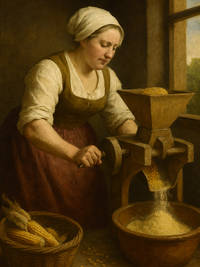
Sybilla Masters: Corn Processing and the Theft of Credit
Sybilla Masters: La Lavorazione del Mais e il Furto del Credito
Sybilla Masters invented a new mechanical method for grinding and cleaning corn in colonial America, but when she traveled to England in 1715 to patent her work, the law required her husband Thomas Masters to hold the document in his name.
Sybilla Masters was a colonial American woman who solved a real mechanical problem: how to grind and clean corn faster and with less effort.
Sybilla Masters era una donna coloniale americana che risolse un vero problema meccanico: come macinare e pulire il granoturco più velocemente e con meno fatica.
In the early 1700s, grinding corn by hand was slow and exhausting.
Nei primi anni del 1700, macinare il granoturco a mano era lento e faticoso.
The tools available were basic, and the work fell largely to women and enslaved people in households.
Gli strumenti disponibili erano semplici, e il lavoro ricadeva in gran parte sulle donne e sulle persone ridotte in schiavitù nelle case.
Masters studied the problem carefully.
Masters studiò il problema con attenzione.
She developed a method of stamping and cleaning corn using a new mechanical approach, different from the standard millstone grinding used at the time.
Sviluppò un metodo per pestare e pulire il granoturco usando un nuovo approccio meccanico, diverso dalla macinatura standard con macina usata all'epoca.
Her process produced cleaner meal with less labor.
Il suo processo produceva farina più pulita con meno fatica.
When she traveled to England in 1715 to seek a patent for her invention, she ran into a hard legal wall.
Quando si recò in Inghilterra nel 1715 per ottenere un brevetto per la sua invenzione, incontrò un duro ostacolo legale.
Under English law at the time, a married woman could not hold a patent in her own name.
Secondo la legge inglese dell'epoca, una donna sposata non poteva detenere un brevetto a proprio nome.
The patent was granted in 1715, but it was recorded under the name of her husband, Thomas Masters, not Sybilla.
Il brevetto fu concesso nel 1715, ma fu registrato a nome di suo marito, Thomas Masters, non di Sybilla.
The same thing happened with a second invention she brought to England.
La stessa cosa accadde con una seconda invenzione che portò in Inghilterra.
Sybilla also developed a method for processing palmetto leaves into hats and bonnets.
Sybilla sviluppò anche un metodo per lavorare le foglie di palmetto in cappelli e cuffie.
That patent, too, was placed in Thomas's name.
Anche quel brevetto fu registrato a nome di Thomas.
Sybilla Masters did the inventing.
Sybilla Masters fu l'inventrice.
Thomas Masters held the legal documents.
Thomas Masters deteneva i documenti legali.
History has largely remembered the name on the paper.
La storia ha in gran parte ricordato il nome sulla carta.
Her story is a reminder that invention and legal recognition are not the same thing.
La sua storia è un promemoria che invenzione e riconoscimento legale non sono la stessa cosa.
Many women throughout history created real solutions to real problems.
Molte donne nel corso della storia hanno creato soluzioni reali a problemi reali.
The records, however, were often written to erase them.
I registri, tuttavia, venivano spesso scritti per cancellarle.
Moral: A name left off a document does not erase the mind that created the work.
Morale: Un nome omesso da un documento non cancella la mente che ha creato l'opera.