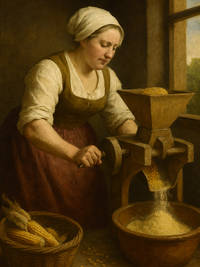
Sybilla Masters: Corn Processing and the Theft of Credit
Sybilla Masters: Corn Processing and the Theft of Credit
Sybilla Masters invented a new mechanical method for grinding and cleaning corn in colonial America, but when she traveled to England in 1715 to patent her work, the law required her husband Thomas Masters to hold the document in his name.
Sybilla Masters was a colonial American woman who solved a real mechanical problem: how to grind and clean corn faster and with less effort.
Sybilla Masters was a colonial American woman who solved a real mechanical problem: how to grind and clean corn faster and with less effort.
In the early 1700s, grinding corn by hand was slow and exhausting.
In the early 1700s, grinding corn by hand was slow and exhausting.
The tools available were basic, and the work fell largely to women and enslaved people in households.
The tools available were basic, and the work fell largely to women and enslaved people in households.
Masters studied the problem carefully.
Masters studied the problem carefully.
She developed a method of stamping and cleaning corn using a new mechanical approach, different from the standard millstone grinding used at the time.
She developed a method of stamping and cleaning corn using a new mechanical approach, different from the standard millstone grinding used at the time.
Her process produced cleaner meal with less labor.
Her process produced cleaner meal with less labor.
When she traveled to England in 1715 to seek a patent for her invention, she ran into a hard legal wall.
When she traveled to England in 1715 to seek a patent for her invention, she ran into a hard legal wall.
Under English law at the time, a married woman could not hold a patent in her own name.
Under English law at the time, a married woman could not hold a patent in her own name.
The patent was granted in 1715, but it was recorded under the name of her husband, Thomas Masters, not Sybilla.
The patent was granted in 1715, but it was recorded under the name of her husband, Thomas Masters, not Sybilla.
The same thing happened with a second invention she brought to England.
The same thing happened with a second invention she brought to England.
Sybilla also developed a method for processing palmetto leaves into hats and bonnets.
Sybilla also developed a method for processing palmetto leaves into hats and bonnets.
That patent, too, was placed in Thomas's name.
That patent, too, was placed in Thomas's name.
Sybilla Masters did the inventing.
Sybilla Masters did the inventing.
Thomas Masters held the legal documents.
Thomas Masters held the legal documents.
History has largely remembered the name on the paper.
History has largely remembered the name on the paper.
Her story is a reminder that invention and legal recognition are not the same thing.
Her story is a reminder that invention and legal recognition are not the same thing.
Many women throughout history created real solutions to real problems.
Many women throughout history created real solutions to real problems.
The records, however, were often written to erase them.
The records, however, were often written to erase them.
Moral: A name left off a document does not erase the mind that created the work.
Moral: A name left off a document does not erase the mind that created the work.