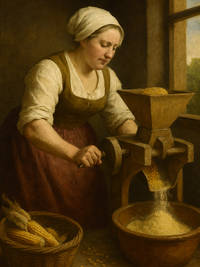
Sybilla Masters: Corn Processing and the Theft of Credit
Sybilla Masters: Maisverarbeitung und der Diebstahl der Anerkennung
Sybilla Masters invented a new mechanical method for grinding and cleaning corn in colonial America, but when she traveled to England in 1715 to patent her work, the law required her husband Thomas Masters to hold the document in his name.
Sybilla Masters was a colonial American woman who solved a real mechanical problem: how to grind and clean corn faster and with less effort.
Sybilla Masters war eine amerikanische Kolonistenfrau, die ein echtes mechanisches Problem löste: wie man Mais schneller und mit weniger Aufwand mahlen und reinigen kann.
In the early 1700s, grinding corn by hand was slow and exhausting.
Im frühen 18. Jahrhundert war das Mahlen von Mais von Hand langsam und erschöpfend.
The tools available were basic, and the work fell largely to women and enslaved people in households.
Die verfügbaren Werkzeuge waren einfach, und die Arbeit fiel größtenteils Frauen und versklavten Menschen in Haushalten zu.
Masters studied the problem carefully.
Masters untersuchte das Problem sorgfältig.
She developed a method of stamping and cleaning corn using a new mechanical approach, different from the standard millstone grinding used at the time.
Sie entwickelte eine Methode zum Stampfen und Reinigen von Mais mit einem neuen mechanischen Ansatz, der sich von dem damals üblichen Mahlstein-Mahlen unterschied.
Her process produced cleaner meal with less labor.
Ihr Verfahren erzeugte saubereres Mehl mit weniger Aufwand.
When she traveled to England in 1715 to seek a patent for her invention, she ran into a hard legal wall.
Als sie 1715 nach England reiste, um für ihre Erfindung ein Patent zu beantragen, stieß sie auf eine harte rechtliche Mauer.
Under English law at the time, a married woman could not hold a patent in her own name.
Nach dem damaligen englischen Recht konnte eine verheiratete Frau kein Patent auf ihren eigenen Namen halten.
The patent was granted in 1715, but it was recorded under the name of her husband, Thomas Masters, not Sybilla.
Das Patent wurde 1715 erteilt, aber es wurde auf den Namen ihres Mannes, Thomas Masters, nicht Sybilla, eingetragen.
The same thing happened with a second invention she brought to England.
Dasselbe geschah mit einer zweiten Erfindung, die sie nach England mitbrachte.
Sybilla also developed a method for processing palmetto leaves into hats and bonnets.
Sybilla entwickelte auch eine Methode zur Verarbeitung von Palmettoblättern zu Hüten und Hauben.
That patent, too, was placed in Thomas's name.
Auch dieses Patent wurde auf Thomas' Namen eingetragen.
Sybilla Masters did the inventing.
Sybilla Masters war die Erfinderin.
Thomas Masters held the legal documents.
Thomas Masters hielt die rechtlichen Dokumente.
History has largely remembered the name on the paper.
Die Geschichte hat größtenteils den Namen auf dem Papier im Gedächtnis behalten.
Her story is a reminder that invention and legal recognition are not the same thing.
Ihre Geschichte ist eine Erinnerung daran, dass Erfindung und rechtliche Anerkennung nicht dasselbe sind.
Many women throughout history created real solutions to real problems.
Viele Frauen haben im Laufe der Geschichte echte Lösungen für echte Probleme geschaffen.
The records, however, were often written to erase them.
Die Aufzeichnungen wurden jedoch oft geschrieben, um sie zu löschen.
Moral: A name left off a document does not erase the mind that created the work.
Moral: Ein Name, der aus einem Dokument fehlt, löscht nicht den Geist, der das Werk geschaffen hat.