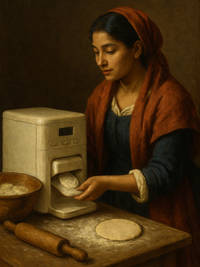
Pranoti Nagarkar-Israni: Construire la Machine Qui Fait le Roti
Pranoti Nagarkar-Israni: Building the Machine That Makes Roti
Pranoti Nagarkar-Israni a cofondé Zimplistic à Singapour et a passé sept ans à concevoir la Rotimatic, une machine automatique à faire du roti lancée en 2017, conçue pour les foyers de la diaspora qui souhaitent du pain plat fait maison sans l'investissement en temps quotidien.
Pranoti Nagarkar-Israni est une ingénieure et entrepreneuse basée à Singapour qui a cofondé la société Zimplistic et passé près d'une décennie à construire la Rotimatic, une machine automatique à faire du roti.
Pranoti Nagarkar-Israni is a Singapore-based engineer and entrepreneur who co-founded the company Zimplistic and spent nearly a decade building the Rotimatic, an automatic roti-making machine.
Faire du roti frais à la main demande du temps, de la pratique et de l'attention.
Making fresh roti by hand takes time, practice, and attention.
Le cuisinier doit mesurer et mélanger la farine, pétrir la pâte jusqu'à la bonne texture, la diviser, étaler chaque morceau en une galette fine et la cuire sur une plaque chaude.
The cook has to measure and mix the flour, knead the dough to the right texture, divide it, roll each piece into a thin round, and cook it on a hot griddle.
Dans les foyers qui mangent du roti chaque jour, ce processus peut prendre trente minutes ou plus de travail concentré.
In households that eat roti every day, this process can take thirty minutes or more of focused work.
Nagarkar-Israni, qui avait grandi en faisant du roti elle-même, y voyait un problème d'ingénierie.
Nagarkar-Israni, who grew up making roti herself, saw this as an engineering problem.
Elle commença à développer une machine capable d'effectuer chaque étape automatiquement : mesurer la farine et l'eau, pétrir, presser et cuire le roti, le tout sans que le cuisinier ait besoin d'y être présent.
She began developing a machine that could handle each step automatically: measuring flour and water, kneading, pressing, and cooking the roti, all without the cook needing to stand over it.
Le développement de la Rotimatic prit environ sept ans.
The development of the Rotimatic took approximately seven years.
Les défis techniques étaient importants.
The engineering challenges were significant.
La pâte se comporte différemment selon le type de farine, l'humidité et le rapport eau-farine.
Dough behaves differently depending on flour type, humidity, and water ratio.
Faire en sorte que la machine produise un roti homogène et bien cuit dans des conditions variables nécessita des années d'itérations.
Getting the machine to produce a consistent, properly cooked roti across variable conditions required years of iteration.
La Rotimatic fut livrée pour la première fois aux clients en 2017.
The Rotimatic was first delivered to customers in 2017.
Il trouva un marché fort parmi les foyers de la diaspora sud-asiatique dans des pays où le roti fait maison faisait partie de la culture alimentaire quotidienne, mais où les contraintes de temps rendaient la fabrication manuelle quotidienne difficile.
It found a strong market among South Asian diaspora households in countries where fresh-made roti was part of daily food culture but time constraints made daily handmaking difficult.
La machine représente un type d'ingénierie spécifique : non pas simplifier une tâche, mais automatiser une tâche culturellement ancrée, techniquement exigeante et profondément familière aux personnes qui en ont le plus besoin.
The machine represents a specific kind of engineering: not simplifying a task, but automating one that is culturally embedded, technically demanding, and deeply familiar to the people who need it most.
Pranoti Nagarkar-Israni construisit quelque chose qui résolut un problème réel pour de vraies familles, et elle le construisit en comprenant à la fois la technologie et la tâche.
Pranoti Nagarkar-Israni built something that solved a real problem for real families, and she built it by understanding both the technology and the task.
Morale : Le meilleur outil pour un problème quotidien vient de quelqu'un qui connaît le problème de l'intérieur.
Moral: The best tool for a daily problem comes from someone who knows the problem from the inside.