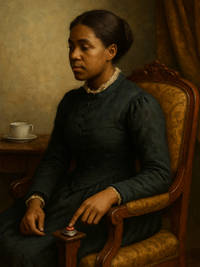
Miriam Benjamin: The Signal Chair and the First Call Button
Miriam Benjamin: De Signaalstoel en de Eerste Oproepknop
In 1888, Miriam Benjamin patented her Gong and Signal Chair, a seat with a button that could summon an attendant without shouting, which was later adopted by the U.S. House of Representatives and made her the second Black woman to hold a U.S. patent.
Miriam Benjamin was an African American inventor who designed a chair that could summon help with the press of a button.
Miriam Benjamin was een Afro-Amerikaanse uitvinder die een stoel ontwierp die hulp kon oproepen met een druk op een knop.
She received a U.S. patent for her Gong and Signal Chair in 1888, becoming only the second Black woman to receive a patent in the United States.
In 1888 ontving ze een Amerikaans patent voor haar Gong and Signal Chair, waarmee ze de tweede Zwarte vrouw werd die een patent in de Verenigde Staten ontving.
The problem Benjamin addressed was simple but persistent.
Het probleem dat Benjamin aanpakte was eenvoudig maar hardnekkig.
In hotels, restaurants, and public rooms, a person who needed service had to wave, call out, or wait to catch the attention of a busy attendant.
In hotels, restaurants en openbare ruimtes moest iemand die bediening nodig had zwaaien, roepen of wachten om de aandacht te trekken van een drukke bediende.
This was slow, disruptive, and unreliable.
Dit was traag, storend en onbetrouwbaar.
Benjamin designed a chair with a button attached to the seat back.
Benjamin ontwierp een stoel met een knop aan de rugleuning.
When pressed, the button activated a signal, such as a light or a gong, to alert staff that this particular seat needed attention.
Bij het indrukken activeerde de knop een signaal, zoals een licht of een gong, om het personeel te waarschuwen dat deze specifieke stoel aandacht nodig had.
The signal was clear, direct, and visible from across the room.
Het signaal was duidelijk, direct en zichtbaar van de andere kant van de kamer.
Her invention was adopted for use in the chambers of the U.S. House of Representatives, where members could alert pages without interrupting proceedings.
Haar uitvinding werd aangenomen voor gebruik in de vergaderzalen van het Amerikaanse Huis van Afgevaardigden, waar leden paginajongens konden waarschuwen zonder de vergadering te onderbreken.
The chair replaced shouting with signaling.
De stoel verving schreeuwen door signaleren.
Benjamin's Gong and Signal Chair was, in effect, an early user interface for human attention.
Benjamins Gong and Signal Chair was in feite een vroege gebruikersinterface voor menselijke aandacht.
It separated the act of requesting help from the chaos of getting noticed.
Het scheidde de handeling van het vragen om hulp van de chaos van opgemerkt worden.
The person in the chair sent a message.
De persoon in de stoel stuurde een bericht.
The attendant received it.
De bediende ontving het.
The interaction was quiet, efficient, and precise.
De interactie was stil, efficiënt en nauwkeurig.
This kind of thinking, turning a need for attention into a designed signal, lies behind hotel call buttons, hospital call systems, and most modern service request interfaces.
Dit soort denken, een behoefte aan aandacht omzetten in een ontworpen signaal, ligt ten grondslag aan hoteloproepknoppen, ziekenhuisoproepsystemen en de meeste moderne interfaces voor serviceverzoeken.
Miriam Benjamin solved a real problem with a clear, repeatable mechanism, and she patented the solution herself.
Miriam Benjamin loste een echt probleem op met een duidelijk, herhaalbaar mechanisme, en ze patenteerde de oplossing zelf.
Moral: A button pressed at the right moment is worth more than a hundred unheard shouts.
Moraal: Een knop die op het juiste moment wordt ingedrukt is meer waard dan honderd ongehoorde kreten.