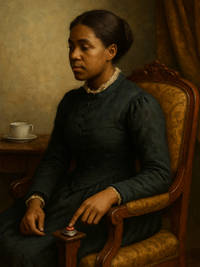
Miriam Benjamin: La Silla de Señales y el Primer Botón de Llamada
Miriam Benjamin: The Signal Chair and the First Call Button
En 1888, Miriam Benjamin patentó su Gong and Signal Chair, un asiento con un botón que podía llamar a un asistente sin gritar, que luego fue adoptado por la Cámara de Representantes de EE. UU. y la convirtió en la segunda mujer negra en poseer una patente estadounidense.
Miriam Benjamin fue una inventora afroamericana que diseñó una silla que podía pedir ayuda con solo presionar un botón.
Miriam Benjamin was an African American inventor who designed a chair that could summon help with the press of a button.
En 1888 recibió una patente estadounidense por su Gong and Signal Chair, convirtiéndose en la segunda mujer negra en recibir una patente en los Estados Unidos.
She received a U.S. patent for her Gong and Signal Chair in 1888, becoming only the second Black woman to receive a patent in the United States.
El problema que Benjamin abordó era simple pero persistente.
The problem Benjamin addressed was simple but persistent.
En hoteles, restaurantes y salas públicas, una persona que necesitaba servicio tenía que hacer señas, llamar o esperar para captar la atención de un ocupado asistente.
In hotels, restaurants, and public rooms, a person who needed service had to wave, call out, or wait to catch the attention of a busy attendant.
Esto era lento, perturbador y poco confiable.
This was slow, disruptive, and unreliable.
Benjamin diseñó una silla con un botón sujeto al respaldo.
Benjamin designed a chair with a button attached to the seat back.
Al presionarlo, el botón activaba una señal, como una luz o un gong, para alertar al personal de que ese asiento en particular necesitaba atención.
When pressed, the button activated a signal, such as a light or a gong, to alert staff that this particular seat needed attention.
La señal era clara, directa y visible desde el otro lado de la sala.
The signal was clear, direct, and visible from across the room.
Su invento fue adoptado para uso en las cámaras de la Cámara de Representantes de los EE. UU., donde los miembros podían avisar a los pajes sin interrumpir las sesiones.
Her invention was adopted for use in the chambers of the U.S. House of Representatives, where members could alert pages without interrupting proceedings.
La silla reemplazó los gritos con señales.
The chair replaced shouting with signaling.
La Gong and Signal Chair de Benjamin era, en efecto, una interfaz de usuario temprana para la atención humana.
Benjamin's Gong and Signal Chair was, in effect, an early user interface for human attention.
Separó el acto de pedir ayuda del caos de hacerse notar.
It separated the act of requesting help from the chaos of getting noticed.
La persona en la silla enviaba un mensaje.
The person in the chair sent a message.
El asistente lo recibía.
The attendant received it.
La interacción era silenciosa, eficiente y precisa.
The interaction was quiet, efficient, and precise.
Este tipo de pensamiento, convertir una necesidad de atención en una señal diseñada, está detrás de los botones de llamada de los hoteles, los sistemas de llamada de los hospitales y la mayoría de las interfaces modernas de solicitud de servicio.
This kind of thinking, turning a need for attention into a designed signal, lies behind hotel call buttons, hospital call systems, and most modern service request interfaces.
Miriam Benjamin resolvió un problema real con un mecanismo claro y repetible, y patentó la solución ella misma.
Miriam Benjamin solved a real problem with a clear, repeatable mechanism, and she patented the solution herself.
Moraleja: Un botón presionado en el momento adecuado vale más que cien gritos no escuchados.
Moral: A button pressed at the right moment is worth more than a hundred unheard shouts.