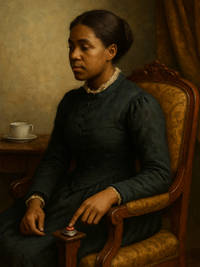
Miriam Benjamin: La Sedia di Segnalazione e il Primo Pulsante di Chiamata
Miriam Benjamin: The Signal Chair and the First Call Button
Nel 1888, Miriam Benjamin brevettò la sua Gong and Signal Chair, un sedile con un pulsante che poteva chiamare un addetto senza urlare, adottato poi dalla Camera dei Rappresentanti degli Stati Uniti, rendendola la seconda donna nera a detenere un brevetto americano.
Miriam Benjamin era una inventrice afroamericana che progettò una sedia in grado di chiamare aiuto con la pressione di un pulsante.
Miriam Benjamin was an African American inventor who designed a chair that could summon help with the press of a button.
Nel 1888 ricevette un brevetto statunitense per la sua Gong and Signal Chair, diventando la seconda donna nera a ricevere un brevetto negli Stati Uniti.
She received a U.S. patent for her Gong and Signal Chair in 1888, becoming only the second Black woman to receive a patent in the United States.
Il problema che Benjamin affrontò era semplice ma persistente.
The problem Benjamin addressed was simple but persistent.
In alberghi, ristoranti e sale pubbliche, chi aveva bisogno di assistenza doveva fare cenni, chiamare o aspettare per attirare l'attenzione di un addetto impegnato.
In hotels, restaurants, and public rooms, a person who needed service had to wave, call out, or wait to catch the attention of a busy attendant.
Era lento, disturbante e poco affidabile.
This was slow, disruptive, and unreliable.
Benjamin progettò una sedia con un pulsante attaccato allo schienale.
Benjamin designed a chair with a button attached to the seat back.
Quando premuto, il pulsante attivava un segnale, come una luce o un gong, per avvisare il personale che quel particolare posto aveva bisogno di attenzione.
When pressed, the button activated a signal, such as a light or a gong, to alert staff that this particular seat needed attention.
Il segnale era chiaro, diretto e visibile dall'altro lato della stanza.
The signal was clear, direct, and visible from across the room.
La sua invenzione fu adottata per l'uso nelle aule della Camera dei Rappresentanti degli Stati Uniti, dove i membri potevano avvisare i commessi senza interrompere le sedute.
Her invention was adopted for use in the chambers of the U.S. House of Representatives, where members could alert pages without interrupting proceedings.
La sedia sostituì le urla con i segnali.
The chair replaced shouting with signaling.
La Gong and Signal Chair di Benjamin era, in effetti, una prima interfaccia utente per l'attenzione umana.
Benjamin's Gong and Signal Chair was, in effect, an early user interface for human attention.
Separava l'atto di chiedere aiuto dal caos di farsi notare.
It separated the act of requesting help from the chaos of getting noticed.
La persona sulla sedia inviava un messaggio.
The person in the chair sent a message.
L'addetto lo riceveva.
The attendant received it.
L'interazione era silenziosa, efficiente e precisa.
The interaction was quiet, efficient, and precise.
Questo tipo di ragionamento, trasformare un bisogno di attenzione in un segnale progettato, è alla base dei pulsanti di chiamata degli hotel, dei sistemi di chiamata degli ospedali e della maggior parte delle moderne interfacce di richiesta servizio.
This kind of thinking, turning a need for attention into a designed signal, lies behind hotel call buttons, hospital call systems, and most modern service request interfaces.
Miriam Benjamin risolse un problema reale con un meccanismo chiaro e ripetibile, e brevettò la soluzione di persona.
Miriam Benjamin solved a real problem with a clear, repeatable mechanism, and she patented the solution herself.
Morale: Un pulsante premuto al momento giusto vale più di cento urla inascoltate.
Moral: A button pressed at the right moment is worth more than a hundred unheard shouts.