Mary Kies: The First U.S. Woman to Hold a Patent
Mary Kies: La Primera Mujer de EE. UU. en Tener una Patente
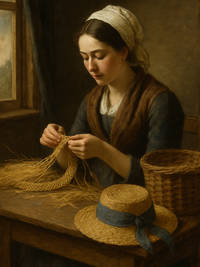
In 1809, Mary Kies became the first woman in the United States to receive a patent, for her technique of weaving straw with silk to produce stronger hat materials during a period of restricted trade.
In the early nineteenth century, a woman named Mary Kies made history in the United States.
A principios del siglo XIX, una mujer llamada Mary Kies hizo historia en los Estados Unidos.
In 1809, she became the first woman to receive a patent from the U.S. government.
En 1809, se convirtió en la primera mujer en recibir una patente del gobierno de los EE. UU.
Her invention was a technique for weaving straw with silk to make hat materials.
Su invento era una técnica para tejer paja con seda para hacer materiales de sombrero.
At the time, imported European hats were expensive and difficult to obtain.
En esa época, los sombreros europeos importados eran caros y difíciles de conseguir.
The United States had recently restricted trade with Britain and France because of ongoing wars in Europe.
Los Estados Unidos habían restringido recientemente el comercio con Gran Bretaña y Francia a causa de las guerras en curso en Europa.
American hat makers needed to find local materials and better methods to meet the demand.
Los fabricantes de sombreros estadounidenses necesitaban encontrar materiales locales y mejores métodos para satisfacer la demanda.
Kies developed a method that allowed straw to be woven together with silk thread in a way that was stronger and more flexible than existing techniques.
Kies desarrolló un método que permitía tejer paja con hilo de seda de una manera más fuerte y flexible que las técnicas existentes.
The resulting material was well suited for making fashionable hats.
El material resultante era adecuado para hacer sombreros de moda.
Her method helped hat makers produce a better product using materials that were available locally.
Su método ayudó a los fabricantes de sombreros a producir un mejor producto usando materiales disponibles localmente.
The patent she received was significant not just for the technique it protected, but for the legal milestone it represented.
La patente que recibió fue significativa no solo por la técnica que protegía, sino por el hito legal que representaba.
Before Kies, married women in the United States had very limited legal standing.
Antes de Kies, las mujeres casadas en los Estados Unidos tenían una capacidad jurídica muy limitada.
A married woman generally could not hold property in her own name.
Una mujer casada generalmente no podía tener propiedades a su propio nombre.
The fact that Kies received a patent showed that the patent system, at least in principle, was open to women.
El hecho de que Kies recibiera una patente demostró que el sistema de patentes, al menos en principio, estaba abierto a las mujeres.
U.S. First Lady Dolley Madison is said to have praised Kies for her contribution to American industry.
Se dice que la Primera Dama de los EE. UU., Dolley Madison, elogió a Kies por su contribución a la industria estadounidense.
The invention was practical, the timing was perfect, and the recognition was real.
El invento era práctico, el momento era perfecto y el reconocimiento era real.
Mary Kies proved that a woman's idea, expressed in a craft as ordinary as hat making, could become an official part of the nation's record of innovation.
Mary Kies demostró que la idea de una mujer, expresada en un oficio tan común como la fabricación de sombreros, podía convertirse en parte oficial del registro de innovación de la nación.
Moral: The first step through a closed door opens a path for everyone who follows.
Moraleja: El primer paso a través de una puerta cerrada abre un camino para todos los que siguen.