Maria Mitchell e la cometa che cambiò tutto
Maria Mitchell and the Comet That Changed Everything
Un’astronoma autodidatta scopre una cometa dal suo osservatorio sul tetto e diventa la prima professoressa di astronomia in America, ispirando generazioni di donne a puntare alle stelle.
Sull’isola di Nantucket nel 1818, Maria Mitchell nacque in una famiglia quacchera che credeva che le ragazze meritassero la stessa istruzione dei ragazzi.
On the island of Nantucket in 1818, Maria Mitchell was born into a Quaker family that believed girls deserved the same education as boys.
Suo padre gestiva una piccola scuola e amava l’astronomia, così insegnò a Maria a misurare le posizioni delle stelle e a calcolarne i movimenti.
Her father ran a small school and loved astronomy, so he taught Maria to measure star positions and calculate their movements.
Mentre le altre ragazze della sua età imparavano solo cucito e buone maniere, Maria studiava matematica e leggeva carte di navigazione alla luce delle candele.
While other girls her age learned only sewing and manners, Maria studied mathematics and read navigation charts by candlelight.
Di giorno, Maria lavorava come bibliotecaria, aiutando i marinai a trovare mappe e rispondendo alle domande sul tempo.
During the day, Maria worked as a librarian, helping sailors find maps and answering questions about the weather.
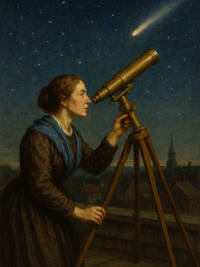
Ma ogni notte limpida saliva sul tetto sopra il negozio del padre e scandagliava il cielo con un piccolo telescopio di bronzo.
But every clear night, she climbed to the rooftop above her father's shop and scanned the sky with a small brass telescope.
La maggior parte della gente in città pensava che l’astronomia fosse solo per professori universitari e osservatori reali in Europa.
Most people in town thought astronomy was only for university professors and royal observatories in Europe.
A Maria non importava cosa dicessero, perché le stelle non chiedevano il permesso di brillare.
Maria did not care what they thought because the stars did not ask for permission to shine.
La sera del 1º ottobre 1847 Maria notò una debole macchia vicino alla Stella Polare che non aveva mai vista prima.
On the evening of October 1, 1847, Maria spotted a faint blur near the North Star that she had never seen before.
Il cuore le batteva forte mentre controllava le sue mappe stellari e capiva che era qualcosa di nuovo, qualcosa che si muoveva.
Her heart raced as she checked her star charts and realized this was something new, something moving.
Chiamò suo padre per confermare e insieme seguirono per ore il misterioso oggetto.
She called her father to confirm, and together they tracked the mysterious object for hours.
Era una cometa e Maria Mitchell l’aveva scoperta prima di qualsiasi astronomo al mondo.
It was a comet, and Maria Mitchell had discovered it before any astronomer in the world.
La notizia della sua scoperta si diffuse in tutta l’America e raggiunse l’Europa, dove il re di Danimarca le assegnò una медaglia d’oro.
News of her discovery spread across America and reached Europe, where the King of Denmark awarded her a gold medal.
Alcuni funzionari cercarono di attribuire il merito a un astronomo che osservò la stessa cometa qualche giorno dopo, ma il padre de Maria aveva registri datati che dimostravano che era stata la prima.
Some officials tried to give credit to a male astronomer who spotted the same comet days later, but Maria's father had dated records proving she was first.
Maria divenne famosa da un giorno all’altro, ma si rifiutò di lasciare che l’attenzione cambiasse la sua missione.
Maria became famous overnight, yet she refused to let the attention change her mission.
Entrò nell’American Academy of Arts and Sciences come prima donna membro e più tardi divenne professoressa al Vassar College.
She joined the American Academy of Arts and Sciences as its first woman member and later became a professor at Vassar College.
In classe, Maria diceva alle giovani donne di mettere in discussione ogni regola che sostenesse che erano troppo deboli o troppo emotive per la scienza.
In her classroom, Maria told young women to question any rule that told them they were too weak or too emotional for science.
Insegnò loro a costruire i propri telescopi, calcolare le orbite e fidarsi delle proprie osservazioni anche quando gli uomini dubitavano di loro.
She taught them to build their own telescopes, calculate orbits, and trust their observations even when men doubted them.
Quando le studentesse temevano di sbagliare, Maria diceva: «Nella scienza abbiamo soprattutto bisogno di immaginazione. Mettete tutto in discussione.»
When students worried about making mistakes, Maria said, "We especially need imagination in science. Question everything."
Aprì il suo osservatorio alle ragazze di famiglie povere e mostrò loro che la curiosità non era un lusso dei ricchi.
She opened her observatory to girls from poor families and showed them that curiosity was not a luxury for the rich.
Maria trascorse la vita a dimostrare che una donna con un telescopio e determinazione poteva cambiare il mondo.
Maria spent her life proving that a woman with a telescope and determination could change the world.
Oggi un cratere sulla Luna e un asteroide portano il suo nome, ricordandoci che il cielo appartiene a tutti.
Today, a crater on the moon and an asteroid bear her name, reminding us that the sky belongs to everyone.
Morale: La curiosità sale più in alto quando ogni osservatore è invitato a condividere il cielo.
Moral: Curiosity climbs higher when every watcher is invited to share the sky.