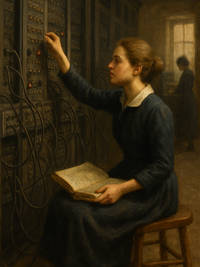
Les Six de l'ENIAC: Elles Inventèrent Comment Réparer un Programme
The ENIAC Six: They Invented How to Fix a Program
Six femmes embauchées pour faire fonctionner le premier ordinateur puissant du monde n'avaient pas de manuel, elles inventèrent donc l'art du débogage, des tests et de la documentation du code de zéro.
Après la Seconde Guerre mondiale, l'ordinateur le plus puissant du monde se trouvait dans un bâtiment à Philadelphie.
After the Second World War, the world's most powerful computer sat in a building in Philadelphia.
Il s'appelait ENIAC.
It was called ENIAC.
Il remplissait toute une pièce de fils, de tubes et de lumières clignotantes.
It filled an entire room with wires, tubes, and blinking lights.
Six femmes furent embauchées pour le faire fonctionner.
Six women were hired to make it work.
Leurs noms étaient Kathleen McNulty, Jean Bartik, Betty Holberton, Marlyn Meltzer, Ruth Teitelbaum et Frances Spence.
Their names were Kathleen McNulty, Jean Bartik, Betty Holberton, Marlyn Meltzer, Ruth Teitelbaum, and Frances Spence.
Elles n'avaient pas de manuel d'instructions.
They had no instruction manual.
Personne n'avait jamais programmé un tel ordinateur auparavant.
Nobody had ever programmed a computer like this before.
Elles durent inventer la méthode au fur et à mesure.
They had to invent the method as they went.
Pour programmer l'ENIAC, elles devaient tracer des chemins à travers des centaines de schémas de câblage.
To program ENIAC, they had to trace paths through hundreds of wire diagrams.
Il n'y avait pas d'écran à regarder.
There was no screen to look at.
Il n'y avait pas de code à lire de la façon dont nous le comprenons aujourd'hui.
There was no code to read in the way we understand today.
Une erreur signifiait un mauvais fil ou un mauvais réglage d'interrupteur quelque part dans un mur de métal et de verre.
A mistake meant a wrong wire or a wrong switch setting somewhere in a wall of metal and glass.
Quand la machine donnait la mauvaise réponse, les femmes devaient trouver pourquoi.
When the machine gave the wrong answer, the women had to find out why.
C'était le début du débogage.
This was the beginning of debugging.
Elles inventèrent des cas de test.
They invented test cases.
Elles effectuaient le même calcul de plusieurs façons pour détecter les erreurs.
They ran the same calculation several ways to catch errors.
Elles créèrent des enregistrements écrits de chaque configuration afin qu'un calcul puisse être répété exactement.
They created written records of every setup so a calculation could be repeated exactly.
Elles développèrent des habitudes qui firent de la programmation un métier enseignable.
They built habits that made programming a teachable craft.
Après la guerre, elles passèrent à d'autres travaux.
After the war, they went on to other work.
Betty Holberton aida à développer les premiers outils logiciels.
Betty Holberton helped develop the first software tools.
Jean Bartik dirigea des équipes construisant la prochaine génération d'ordinateurs.
Jean Bartik led teams building the next generation of computers.
Leurs méthodes se répandirent sans reconnaissance, absorbées dans un domaine qui ne se rappelait pas toujours d'où elles venaient.
Their methods spread without credit, absorbed into a field that did not always remember where the methods came from.
Mais la façon dont un programmeur vérifie aujourd'hui son travail, écrit un test et tient un journal de ce qu'il a modifié, ces habitudes ont été façonnées dans cette salle, par ces six femmes, avec des câbles de connexion et de la patience.
But the way a programmer today checks their work, writes a test, and keeps a log of what they changed, those habits were shaped in that room, by those six women, with patch cords and patience.
Morale: Chaque métier a besoin de ses premiers maîtres, et les maîtres oubliés sont ceux qui ont le plus façonné le métier.
Moral: Every craft needs its first masters, and the masters who are forgotten shaped the craft the most.