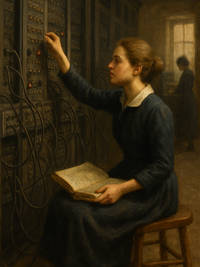
Le Sei dell'ENIAC: Inventarono Come Correggere un Programma
The ENIAC Six: They Invented How to Fix a Program
Sei donne assunte per far funzionare il primo potente computer del mondo non avevano un manuale, così inventarono l'arte del debugging, del testing e della documentazione del codice da zero.
Dopo la Seconda Guerra Mondiale, il computer più potente del mondo si trovava in un edificio a Philadelphia.
After the Second World War, the world's most powerful computer sat in a building in Philadelphia.
Si chiamava ENIAC.
It was called ENIAC.
Riempiva un'intera stanza di fili, tubi e luci lampeggianti.
It filled an entire room with wires, tubes, and blinking lights.
Sei donne furono assunte per farlo funzionare.
Six women were hired to make it work.
I loro nomi erano Kathleen McNulty, Jean Bartik, Betty Holberton, Marlyn Meltzer, Ruth Teitelbaum e Frances Spence.
Their names were Kathleen McNulty, Jean Bartik, Betty Holberton, Marlyn Meltzer, Ruth Teitelbaum, and Frances Spence.
Non avevano un manuale d'istruzioni.
They had no instruction manual.
Nessuno aveva mai programmato un computer come questo prima.
Nobody had ever programmed a computer like this before.
Dovevano inventare il metodo mentre andavano.
They had to invent the method as they went.
Per programmare l'ENIAC, dovevano tracciare percorsi attraverso centinaia di diagrammi di cavi.
To program ENIAC, they had to trace paths through hundreds of wire diagrams.
Non c'era nessuno schermo da guardare.
There was no screen to look at.
Non c'era codice da leggere nel modo in cui lo intendiamo oggi.
There was no code to read in the way we understand today.
Un errore significava un filo sbagliato o un'impostazione di interruttore errata da qualche parte in una parete di metallo e vetro.
A mistake meant a wrong wire or a wrong switch setting somewhere in a wall of metal and glass.
Quando la macchina dava la risposta sbagliata, le donne dovevano scoprire perché.
When the machine gave the wrong answer, the women had to find out why.
Questo fu l'inizio del debugging.
This was the beginning of debugging.
Inventarono i casi di test.
They invented test cases.
Eseguivano lo stesso calcolo in più modi per individuare gli errori.
They ran the same calculation several ways to catch errors.
Crearono registrazioni scritte di ogni configurazione affinché un calcolo potesse essere ripetuto esattamente.
They created written records of every setup so a calculation could be repeated exactly.
Svilupparono abitudini che resero la programmazione un mestiere insegnabile.
They built habits that made programming a teachable craft.
Dopo la guerra, continuarono con altri lavori.
After the war, they went on to other work.
Betty Holberton aiutò a sviluppare i primi strumenti software.
Betty Holberton helped develop the first software tools.
Jean Bartik guidò team che costruivano la prossima generazione di computer.
Jean Bartik led teams building the next generation of computers.
I loro metodi si diffusero senza riconoscimento, assorbiti in un campo che non ricordava sempre da dove provenissero.
Their methods spread without credit, absorbed into a field that did not always remember where the methods came from.
Ma il modo in cui un programmatore oggi controlla il proprio lavoro, scrive un test e tiene un registro di ciò che ha cambiato, queste abitudini furono forgiate in quella stanza, da quelle sei donne, con cavi patch e pazienza.
But the way a programmer today checks their work, writes a test, and keeps a log of what they changed, those habits were shaped in that room, by those six women, with patch cords and patience.
Morale: Ogni mestiere ha bisogno dei suoi primi maestri, e i maestri dimenticati hanno plasmato il mestiere più di tutti.
Moral: Every craft needs its first masters, and the masters who are forgotten shaped the craft the most.