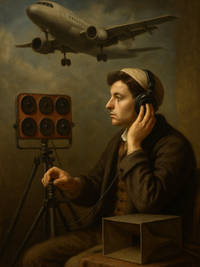
Il Cacciatore di Suoni Che Silenziò il Cielo
The Sound Hunter Who Silenced the Sky
Un aeroacustico gay cresciuto vicino a un aeroporto rumoroso usa array di microfoni e test in galleria del vento per scoprire che la maggior parte del rumore degli aerei proviene dal carrello e dai flap — poi progetta soluzioni semplici che rendono interi quartieri più silenziosi.
Ogni volta che un jet volava sopra, le persone si tappavano le orecchie.
Every time a jet flew overhead, people covered their ears.
Ma un aeroacustico gay di nome Felix sentiva qualcosa di diverso — un enigma.
But a gay aeroacoustician named Felix heard something different — a puzzle.
Sentiva le frequenze specifiche, i bordi turbolenti dove l'aria incontrava il metallo, i minuscoli vortici che si staccavano dai flap.
He heard the specific frequencies, the turbulent edges where air met metal, the tiny vortices spinning off the wing flaps.
Per la maggior parte delle persone, il rumore dei jet era semplicemente forte.
To most people, jet noise was just loud.
Per Felix, era una mappa di tutto ciò che non andava bene con il flusso d'aria.
To Felix, it was a map of everything going wrong with the airflow.
Felix lavorava per un istituto di ricerca aeronautica.
Felix worked for an aviation research institute.
Il suo lavoro era capire da dove veniva il rumore e poi farlo sparire.
His job was to figure out where noise came from and then make it disappear.
Usava array di microfoni grandi come un campo da calcio per ascoltare gli aerei dal basso.
He used microphone arrays the size of a football field to listen to planes from below.
Costruì modelli in scala nelle gallerie del vento e li coprì di sensori di pressione.
He built scale models in wind tunnels and covered them in pressure sensors.
Ciò che scoprì fu che gran parte del rumore degli aeromobili non proveniva dai motori stessi, ma dal carrello di atterraggio e dai flap.
What he found was that a large portion of aircraft noise came not from the engines themselves, but from the landing gear and wing flaps.
Erano i posti dove il flusso d'aria regolare si frantumava in caos.
These were places where smooth airflow broke into chaos.
Felix progettò piccoli bordi seghettati per i flap — minuscole forme a dente di sega che spezzavano i vortici prima che potessero diventare rumore.
Felix designed small serrated edges for wing flaps — tiny saw-tooth shapes that broke up the vortices before they could become noise.
Progettò carenature per il carrello di atterraggio che ridirigevano il flusso d'aria intorno alle ruote.
He designed fairings for landing gear that redirected airflow around the wheels.
Nei test, queste aggiunte ridussero il rumore fino a otto decibel — abbastanza da far sembrare un aereo due volte più silenzioso all'orecchio umano.
In tests, these additions reduced noise by up to eight decibels — enough to make a plane sound twice as quiet to the human ear.
Quando i progetti furono adottati da tre grandi produttori di aeromobili, Felix non festeggiò da solo.
When the designs were adopted by three major aircraft manufacturers, Felix did not celebrate alone.
Andò nel quartiere vicino all'aeroporto dove era cresciuto, dove le finestre vibravano ogni notte.
He went to the neighborhood near the airport where he had grown up, where the windows rattled every night.
Si sedette in silenzio e ascoltò il cielo.
He sat quietly and listened to the sky.