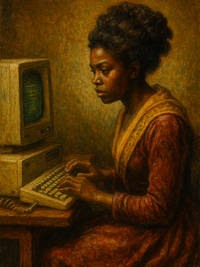
Janet przełamuje bariery w historii komputerów
Janet Breaks Computer History Barriers
Janet kocha komputery i marzy o zapisaniu się w historii świata technologii. Ale przełamywanie barier nie jest łatwe, gdy wszyscy wątpią w to, co może zrobić.
Janet loved computers.
She worked with them every day.
But Janet saw a big problem at work.
Her company had many workers.
The workers came from different countries.
They spoke different languages.
Some workers felt left out.
"This is not fair," Janet said.
She watched her coworkers struggle.
Some people got better jobs than others.
The reasons were not always good.
Janet had an idea.
She would create special computer software.
This software would help companies be more fair.
It would track how workers were treated.
Every night, Janet worked on her computer.
She wrote code for hours.
Her fingers moved fast on the keyboard.
She drank lots of coffee to stay awake.
"I can solve this problem," she told herself.
Janet believed in her dream.
She wanted to help all workers.
The software was very smart.
It could watch how companies hired people.
It could see if companies were being unfair.
The software would warn companies about problems.
Janet finished her software after many months.
Now she needed to protect her idea.
She decided to get a patent.
A patent is like a special paper.
It says you invented something first.
Nobody else can copy your invention without permission.
Janet filled out many forms.
She wrote long explanations about her software.
The patent office had to understand her invention completely.
Weeks passed.
Then months passed.
Janet waited and waited.
Would the patent office say yes or no?
Other people doubted Janet.
"Women don't get software patents," they said.
"Especially not Black women," others whispered.
But Janet did not give up.
She believed her software was important.
She knew it could help millions of workers.
Finally, the letter came.
Janet opened it with shaking hands.
Her heart beat very fast.
"YES!"
she shouted.
The patent office approved her application.
Janet became the first Black woman to get a software patent.
Her software was officially hers.
Nobody could steal her idea now.
Janet felt proud and happy.
Soon, many companies wanted Janet's software.
They paid her lots of money for it.
The software helped create fairer workplaces everywhere.
Janet's invention changed how companies worked.
Workers were treated more equally.
People from all backgrounds got better chances.
Years later, Janet started her own company.
She hired workers from many different backgrounds.
Her office was a fair and happy place.
"Never give up on your dreams," Janet told young inventors.
"Your ideas can change the world."
Janet proved that anyone can be an inventor.
She showed that hard work pays off.
Her story inspired thousands of other women.
Today, Janet's software still helps companies.
Her patent opened doors for other inventors too.
She made history with her brilliant mind.